
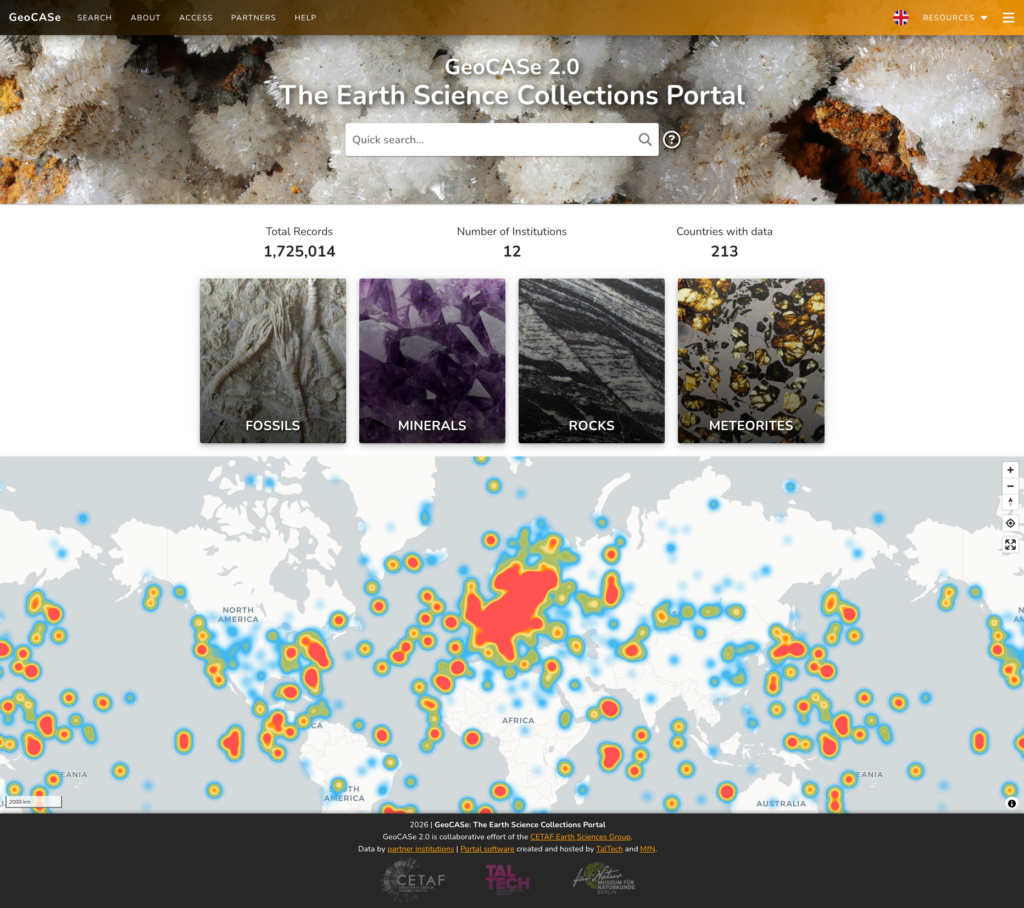
GeoCASe stands for Geoscience Collections Access Service. It is a data network and web portal designed to make collections of minerals, rocks, meteorites and fossils held in museums and research institutions universally available online, in order to foster scientific research and collaboration internationally.
Data for GeoCASe network are provided by individual museums and research institutions, most commonly via the BioCASe Provider Software using XML-based data exchange standards ABCD (Access to Biological Collections Data) and ABCD-EFG (ABCD Extension for Geosciences; see Petersen et al. 2018). GeoCASe service “harvests” these data sources, stores the records in index and makes them easily accessible and searchable from a single user interface. GeoCASe aims to become the Earth Science counterpart of GBIF, the Global Biodiversity Information Facility used by thousands of institutions and researchers.
The initial version of GeoCASe was built at the Museum für Naturkunde, Berlin, as part of SYNTHESYS project in 2007. Development of an upgraded version, GeoCASE 2.0, started in 2020 by the Museum für Naturkunde and Tallinn University of Technology under coordination of the CETAF ESG (Consortium of European Taxonomic Facilities, Earth Science Group). Being a product of CETAF, which is a well established cohesive community of European Natural Science research institutes containing a wide-range of expertise in taxonomy, training, data standards and taxonomy, ensures that GeoCASe is reliable and sustainable in serving the needs of the wider community. GeoCASe will also become aligned with the DiSSCo Research Infrastructure.
GeoCASe is currently managed by the ‘GeoCASe advisory board’ who are responsible for the development, maintenance, promotion and quality control of the portal.
GeoCASe 2.0 is a collaborative effort of the CETAF Earth Sciences Group. Data by partner institutions | Portal software created and hosted by TalTech and MfN.
DiSSCo & CETAF Helpdesk
Keywords
Partners
University of Tallinn
Science Group